My role models, the Dervaes family, just posted their April and year-to-date harvest tallies. While I know that they have the great fortune of living in a year-round gardening climate, I can still be jealous! Here are the numbers:
APRIL HARVEST276 lb produce
Eggs 141 (Duck) 73 (Chicken)
2011 YEAR TO DATE939 lb produce
Eggs 486 (Duck) 190 (Chicken)
Living here in the tundra, I haven't been so lucky. I, so far, have only gotten a few heads of lettuce :(
Tuesday, May 10, 2011

Wednesday, May 4, 2011
Square Foot Gardening
Some time ago, one of my wife's friends mentioned to her that she wanted to try 'quadrant gardening' this year. Not having spoken to her, I am guessing that she meant some version of Square Foot Gardening (though she could have meant that she was planning to purchase these.)
Either way, this will be a post on Square Foot Gardening...a method developed by Mel Bartholomew. Think of this as an exploration of a gardening method as well as a book review.
Mel Bartholomew's method is not a new concept. The idea of using close spacing and of growing vertically was used by the Myans, the 18th century French, and the 19th century English. What Mel Bartholomew has done, though, is make it easy!
Here's the basic idea.
After building a square frame (i.e. no bottom) that is 4ft long on each side, lay out dividers in each direction spaced 1 foot apart. You should end up with a checkerboard-style grid. Now, after adding dirt of course, place one plant in each square (some plants, like lettuce and carrots can have more than one per square). The result should look something like this:

Notice the trellis in the back. Here's another look at a trellised SFG:

The trellis allows climbing veggies like peas and beans to really stretch themselves and grow to their full potential.
The beauty of this ststem, too, is that it can be scaled up as a person wants to grow more, like this
So...how do you know how many plants to put in each square or how to arrange them? You could but Mel's book or you could consult planning software like this. The planning software will show you that you could, in 3x6 foot space, create a high yield garden
an All American Garden
or about a dozen others.
The planning software that I have linked to goes on to show a grid of the layout for the garden as well as outline how many of each plant to place into each square. I structure my garden similar to some of these plans and to Mel's methods and I get HUGE results from a small space!
Mel Bartholomew has done something else besides make small space gardening techniques easy - he has built himself a business! What started as a single book has become a full blown website with a brand new edition to the book as well as a store selling everything that you need to get started and be successful at gardening.
While I applaud Mel for taking a lot of the guesswork out of the process, I don't know if gardening is quite as easy as he makes it seem. I think that his method of dividing the space into visible squares makes the garden seem more organized and managable in the mind rather than actually making it foolproof.
I do plan to test one of his claims this year. His book states that '16 square feet are needed to provide one person a daily salad throughout the growing season.' He then claims that 'an additional 16 square feet will provide all of the dinner table vegetables for that one person.' A final '16 square feet will provide all of the veggies needed for preserving.' This adds up to 48 square feet or just three of the 4ft by 4ft boxes that are Mel's standard!
While I don't plan to preserve too much of this year's harvest, I do want to see if my 110 square foot garden can provide all of the salads and veggies that my family needs this growing season. Based on 32sq ft per adult and half that per child, I should only need 96 sq ft for my fresh veggies. We shall see!
Either way, this will be a post on Square Foot Gardening...a method developed by Mel Bartholomew. Think of this as an exploration of a gardening method as well as a book review.
Mel Bartholomew's method is not a new concept. The idea of using close spacing and of growing vertically was used by the Myans, the 18th century French, and the 19th century English. What Mel Bartholomew has done, though, is make it easy!
Here's the basic idea.
After building a square frame (i.e. no bottom) that is 4ft long on each side, lay out dividers in each direction spaced 1 foot apart. You should end up with a checkerboard-style grid. Now, after adding dirt of course, place one plant in each square (some plants, like lettuce and carrots can have more than one per square). The result should look something like this:

Notice the trellis in the back. Here's another look at a trellised SFG:

The trellis allows climbing veggies like peas and beans to really stretch themselves and grow to their full potential.
The beauty of this ststem, too, is that it can be scaled up as a person wants to grow more, like this

So...how do you know how many plants to put in each square or how to arrange them? You could but Mel's book or you could consult planning software like this. The planning software will show you that you could, in 3x6 foot space, create a high yield garden

an All American Garden

or about a dozen others.
The planning software that I have linked to goes on to show a grid of the layout for the garden as well as outline how many of each plant to place into each square. I structure my garden similar to some of these plans and to Mel's methods and I get HUGE results from a small space!
Mel Bartholomew has done something else besides make small space gardening techniques easy - he has built himself a business! What started as a single book has become a full blown website with a brand new edition to the book as well as a store selling everything that you need to get started and be successful at gardening.
While I applaud Mel for taking a lot of the guesswork out of the process, I don't know if gardening is quite as easy as he makes it seem. I think that his method of dividing the space into visible squares makes the garden seem more organized and managable in the mind rather than actually making it foolproof.
I do plan to test one of his claims this year. His book states that '16 square feet are needed to provide one person a daily salad throughout the growing season.' He then claims that 'an additional 16 square feet will provide all of the dinner table vegetables for that one person.' A final '16 square feet will provide all of the veggies needed for preserving.' This adds up to 48 square feet or just three of the 4ft by 4ft boxes that are Mel's standard!
While I don't plan to preserve too much of this year's harvest, I do want to see if my 110 square foot garden can provide all of the salads and veggies that my family needs this growing season. Based on 32sq ft per adult and half that per child, I should only need 96 sq ft for my fresh veggies. We shall see!
Tuesday, May 3, 2011
Seed Pack info
A couple of posts ago, promised a primer on the information found on the back of seed packets. Here goes:
Veggie seed packs are typically all the same - they offer a pic of the plant on the front...

...and info about the plant on the back

Here's another example of the front of a pack...

...and the back
 (Notice that the first seed pack states 'hybrid' and that the second does not. Take a look at our discussion of hybrids for more info!)
So...what are these seed packs telling us?
First of all, notice that the backs of the packs start with a short description of the plant. This is nice info but the really good stuff comes next.
The next item (which is toward the end of the description) is the word 'indeterminate.' This is critical because it tells you how long the plant will produce its veggie. An indeterminant variety will produce fruit all season long. This differs from a 'determinant' variety which will only produce for a short time - perhaps only a few weeks.
It's not that one is better than another - you just have to know what you have so that you can work with it. If you want to grow determinant varieties, you'll have to plan and stagger your plantings so that you end up with a season full of veggies...and not just a few weeks with veggies comming out of your ears!
One other thing to think about (and this is more for advanced gardeners) is that determinant varieties tend to 'bush' whereas indeterminant varieties tend to 'vine.' This means that if you want to have your...let's say tomatoes...climb up a very tall cage or a chainlink fence, go with the indeterminant type. The reason that I say that this is for advanced gardeners is because if you understand how plants climb, you can squeese more into a small space. To do that, though, you have to plan very precisely!
Ok - now that we know how long the plant will give us veggies, we have to know the first point when we will be able to pick.
Here's where the 'Harvest in __ days' comes in. The first plant that I have here is a 70 day (or 10 weeks) while the second is an 80 day (or 11.5 weeks), so you'll have to wait a little longer.
The second packet offers a little more insight into this. It states '80 days from transplant.' This is critical and leads me to the next piece of info on the packet.
Both packets state 'start indoors' and '6-8 weeks before transplant.'
Remember the 70 or 80 days till harvest? This means after planting outside!!! You've actually got to plan in the x-tra 42-56 days for the seedling to grow indoors.
How do you know how to plan for those x-tra days and when to plant your seedlings outside? Review the tools that we talked about in January here, here, and here.
According to all of this info, I can figure out that I need to start my tomatoes between March 15th and April 1st and that I won't have my first 'Super 100s' until about the 24th opf July and I won't have my first Wisconsin 55s until about August 1st!
The last bit of info that the packet tells me is how far apart I should space my plants. This is for the type of gardening that most of us are aware of (i.e. stick a plant in the ground here and there and water).
The more advanced gardening that I spoke of earlier shrinks the space between plants drastically but coaxes them to grow vertically.
More ont hat tomorrow...
Monday, May 2, 2011
May Day, Walpurgisnacht, and Beltane
YEAH!!!!
I'm back to blogging regularily now that I've completed my master's degree!!
That personal celebration lines up with a much more widely-known celebration known as May Day or Walpurgisnacht or Beltane, depending on what part of the world you might be in.
By any name, the celebration which occurs on the evening of April 30th as it transitions into May 1st marks a particularily significant change gardeners. This day is the transition from the non-growing season to the growing season in northern climates.
I've talked before about coldframes, row covers, and greenhouses and without some type of protection like these, gardening is quite difficult to nearly impossible in northern climates before about May 1st.
Southern climate dwellers know that May first as a starting date is quite late. I did a post 3 months ago which had a picture from California first showing signs of spring.
Well...three months later, here are my first signs of spring:
 The first buds on a tree
 Lettuce first leaving the protection of the coldframe
 Peas loving the still-cool temps


 Tomatoes, peppers, and zucchinni ready for planting out in a few weeks!
I'm back to blogging regularily now that I've completed my master's degree!!
That personal celebration lines up with a much more widely-known celebration known as May Day or Walpurgisnacht or Beltane, depending on what part of the world you might be in.
By any name, the celebration which occurs on the evening of April 30th as it transitions into May 1st marks a particularily significant change gardeners. This day is the transition from the non-growing season to the growing season in northern climates.
I've talked before about coldframes, row covers, and greenhouses and without some type of protection like these, gardening is quite difficult to nearly impossible in northern climates before about May 1st.


Southern climate dwellers know that May first as a starting date is quite late. I did a post 3 months ago which had a picture from California first showing signs of spring.

Well...three months later, here are my first signs of spring:
 The first buds on a tree
 Lettuce first leaving the protection of the coldframe
 Peas loving the still-cool temps
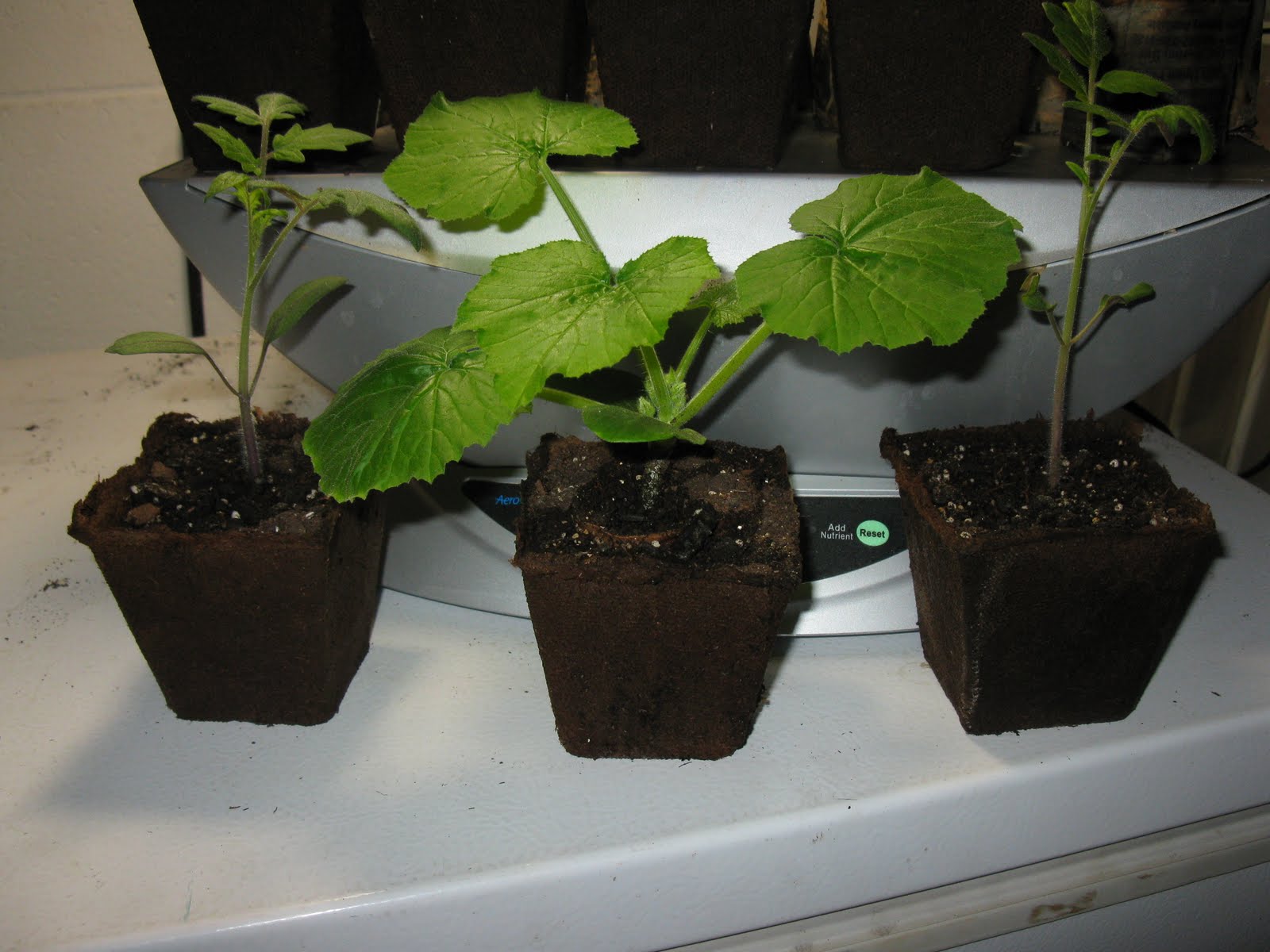

 Tomatoes, peppers, and zucchinni ready for planting out in a few weeks!
Wednesday, April 13, 2011
Heirloom vs Organic...vs Hybrid
Ok readers...this is going to be a 'must read.'
I've had several conversations and questions in the past few weeks about the differences between heirloom and organic plants. I'm going to offer a quick summary here that should clarify things.
Let me, though, say this: Organic and Heirloom ARE NOTthe same thing.
To start with, let's talk about genetics!
If you happen to find yourself with 2 Labrador Retrievers and you allow them to...er...make babies, you will get...
You guessed it - Labrador Retrievers!
If you have 2 poodles and you do the same thing, you will get...poodles!
If, though, you have one Lab and one Poodle, and you breed them, you would get a...
LABRADOODLE!
How does this work with plants?
If you have one particular tomato plant that you keep breeding, say...a Brandywine, you will continuously have Brandywines. If you carefully protect the genetics and don't allow them to mix for somewhere between 50 and 100 years (the jury is still out on this one), you will have an HEIRLOOM variety.
If you mix two different kinds of tomatoes, though, you get a HYBRID.
Why is hybridization done? Usually it's to isolate a desired trait, like early production (Early Girl Tomato), plant reliability (Better Boy Tomato), flavor (Beefsteak tomato), or harvest time consistency (Roma tomato...used in Heinz Catsup).
Is there a problem, then, with hybrids?
If you want to buy plants every year, stick them in the ground, and know that you'll have a fairly successful harvest...no...there is nothing wrong with hybrids!
If, though, you'd like to cut one or two of those Early Girl tomatoes open at the end of the year, pull the seeds out, and dry&save them to plant next year...yes...there would be HUGE proble with hybrids!!!
Why?
Most hybrid veggies that we can get are known as F1 or Filial Generation One. This means that the seed or plant is the result of just one Lab/Poodle mix.
The thing with genetics, though, is that they are SLOW to change. Once the hybrid plant grows and produces seeds, the seeds don't really want to be hybrid any more.
So... if you plant the seeds that you saved from your Early Girl, some of the plants that grow will look like one parent, some will look likethe other parent, some will be quite deformed, and just a small few MIGHT look like Early Girls.
There are also F2 and F3 hybrids. F2s result from breeding two F1 Early Girls. F3s result from breeding 2 F2 Early Girls. This is where the genetics get tricky. If 2 parents are chosen for flavor, an F1 is created. If 2 different parents are chosen for reliability, a second F1 is created. If these two F1s are bread to make an F2, the F2 would have 4 genetic lines. If this process is repeated a second time, another F2 would be created. When both of those F2s are bred, the resulting F3 might be an overall superior plant but would have 8 genetic lines within it and, as the consumers, we could never replicate this if we tried to save the seeds for the following year. This means that our plants that we grew from saved seeds could look REALLY wierd and might not produce all that well.
Some thing important to remember this that ALL plants on Earth are hybrids. Unless you grow a plant in a sealed box, mixing if genetic material WILL happen through pollination. When I said, though, that genetic change happens slow, what I meant was that the genetics of hybrids will eventually stabilize so that seed that is saved will grow well the next year. The only way to stabilize the hybrid, though, is time...lots of time!
The Early Girl has been on the market since about 1975, or for 36 years (generations). Each year, the plant is re-hybridized in order to force its genetics to remain identical.
The Brandywine tomato has been on the market since about 1885, or 126 years (generations). During that time, it has been allowed to adapt to changing conditions and has been allowed to evolve naturally as it aquires additional genetic traits through natural cross-pollination.
Notice that I haven't talked about organic at all.
This is because organic refers to HOW something is grown (as opposed to heirloom and hybrid which refer to WHAT is grown). Either heirloom or hybrid plants can be grown organically...that is - without chemical fertilizers and pesticides.
The question that you need to ask yourself when buying seed/plants is what you are ok with growing.
Hybrids have more uniform flavor and shape and are typically easier to grow. You don't know, though, what plants have been mixed in order to get the hybrid and you won't be able to make a 1-time seed investment - you'll have to buy new seed/plants each year.
Heirlooms can vary in their flavor and shape (I personally like the fact that they are 'more interesting') and are more difficult to grow (read: they need to be loved). For that, though, you can know that the varieties have a long history and you'll be able to save seed and use it again the next year.
Either way, try to make the move to growing organically - the reason that we garden in the first place is to put fewer chemicals into our bodies!
Subscribe to:
Posts (Atom)